You landed on our PicoFlasher build — firmware that turns a Raspberry Pi Pico into an Xbox 360 NAND programmer (the NAND is the flash chip storing the console's firmware) — and the page promises it will "prepare a console for RGH or JTAG homebrew." If those are just letters to you, this page is for you: RGH and JTAG are the two classic ways to make an Xbox 360 run unsigned code — software Microsoft never approved. Here's what each one is, how the "glitch" trick works, what a glitch chip or a timing file does, what can go wrong, and where to start with a Raspberry Pi Pico.
What RGH is, in plain English
The one-sentence version
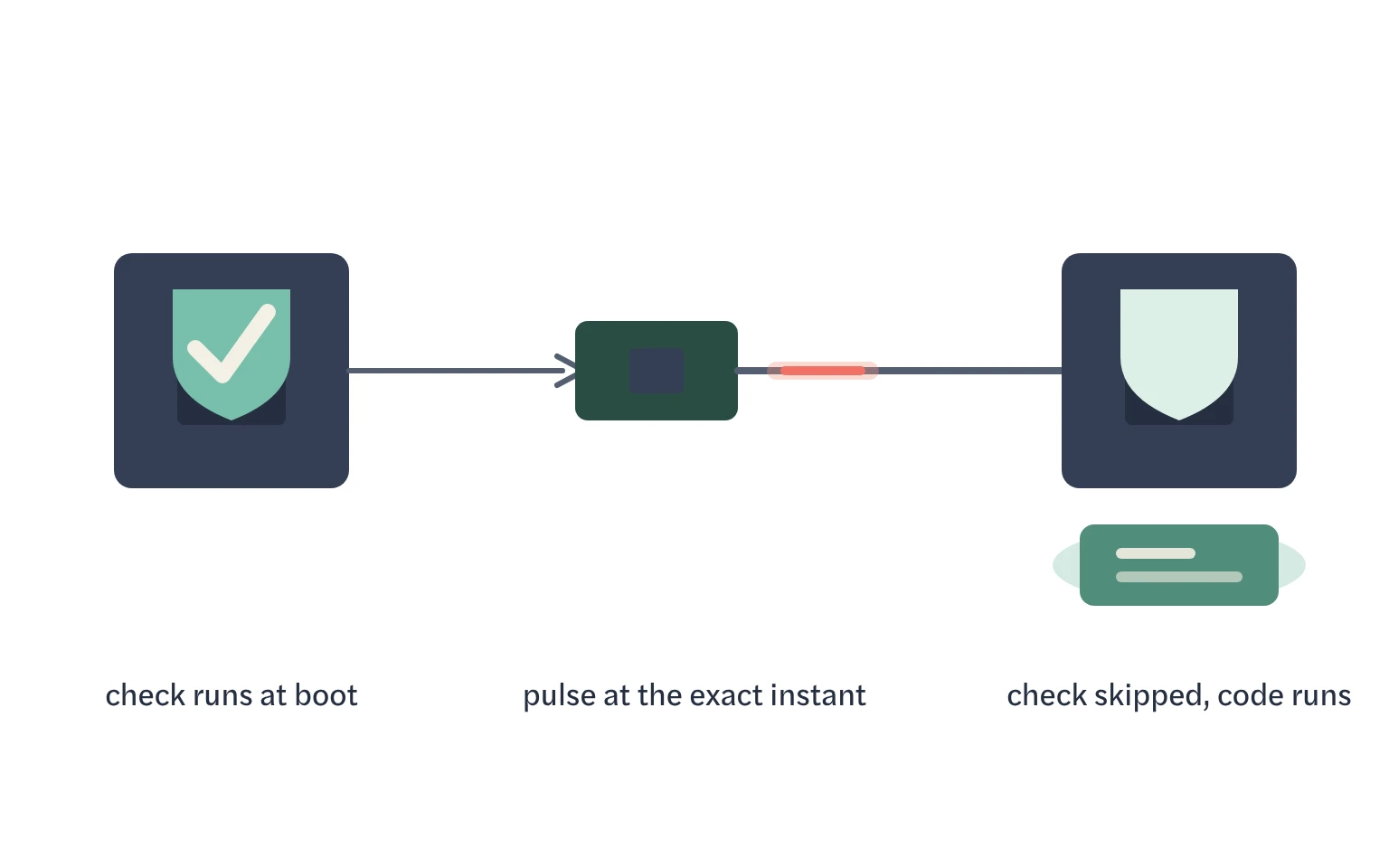
RGH (Reset Glitch Hack) resets the console's processor at one carefully chosen instant during boot, so the processor carries out its own security check incorrectly — and lets in code Microsoft never signed. That's the whole trick. When an Xbox 360 starts, each stage of the boot chain verifies that the next stage carries Microsoft's signature before running it, and the first-stage loader lives in the CPU silicon itself. RGH doesn't break that chain's cryptography: the check still runs, it just runs wrong, and unsigned code — homebrew — gets through. The vulnerability was found by modder GliGli, and the exploit dates back to 2011.
Why "glitch" is in the name
The glitch is a hardware glitch — a pulse of electricity, not a password and not a math breakthrough. Pulsing the CPU's reset line for on the order of 100 nanoseconds doesn't reboot the chip at all: the processor mis-executes the instruction it's on instead. Strike exactly the right instant, and an instruction inside the signature check stores the wrong value, so the check passes. In other words, the console's own boot check is interrupted — not defeated by cryptography.
What "JTAG" means on a modded Xbox 360
A debug port, and an exploit named after it
JTAG, by origin, is a debug port: standard test points on a circuit board that let engineers pause, inspect and program a chip. Tom's Hardware's history of 360 cracking lists the 2009 "wiring hack exposing JTAG debugging ports" as the third major break-in. On the Xbox 360, "the JTAG hack" (properly the SMC hack) was the first permanent modification that let the original "phat" consoles run unsigned code, mods, game backups and homebrew. It combined two things: the SMC — a controller chip on the console's motherboard — and the GPU's JTAG port, which the exploit used to run its code.
Why the name confuses newcomers
Because the hack depended on Microsoft's old boot code, it's now history: dashboard updates after 2.0.7371 blacklist the vulnerable kernel and burn eFuses so the console can't be downgraded, which patched the exploit for good. So today "JTAG" the mod means "an old-kernel exploit from 2009," while JTAG the debug port is alive and well — it's the family of interface our CMSIS-DAP debug probe project uses to program Pico and Arm chips. When a guide says JTAG, check which one it means.
RGH vs JTAG: which is which
Same goal, different door
Both routes end at the same place: unsigned code — homebrew, dashboards, emulators, backups — running on your console. The doors differ. The JTAG hack is an exploit: if your console's boot code is old enough, wiring the right points together lets the already-flawed boot chain do the rest — the wiki calls it the first permanent modification, because once written it simply keeps working on every boot. RGH is a hardware attack: it works on newer consoles by glitching the processor at boot, and it has grown a variant for nearly every motherboard — RGH2 works on any dashboard, and RGH3, the newest, needs no glitch chip at all because the southbridge does the glitching. The trade-off is that an RGH console re-runs its timing trick every single boot, so a badly tuned one can take several attempts before it glitches and comes up.
| Aspect | RGH | JTAG |
|---|---|---|
| What it is | A hardware timing attack: a precisely-timed pulse to the CPU's reset line makes the boot-time signature check pass unsigned code | The SMC hack: wiring on consoles with old boot code lets unsigned code run via the SMC and the GPU's JTAG port |
| Which consoles | Nearly all motherboards, Slims included — variants from RGH1 through RGH3 (which needs no glitch chip) | Original "phat" consoles (Xenon, Zephyr, Falcon, Opus, Jasper) on dashboard 7371 or lower with an exploitable CB version |
| Extra hardware | A glitch chip programmed with per-console timing (RGH3: none) | Soldered wiring between the JTAG points; no glitch chip |
| Newcomer risk | Soldering to small pads plus tuning the timing until the console glitches and boots reliably | Soldering to small pads; a wrong write can brick the console |
Which one your console can take
Two things decide it, and you can check both: the motherboard model and the dashboard version. JTAG needs a phat console on dashboard 7371 or lower, with an exploitable CB bootloader version — J-Runner reads that from your NAND dump. Almost everything else takes one RGH variant or another, and you'll see the split reflected in the tools: J-Runner's write modes are literally labelled JTAG, Glitch (RGH1) and Glitch2 (the later RGH variants). We deliberately don't reproduce the per-model matrix here: the ConsoleMods wiki's recommended-exploit chart matches every motherboard and dashboard to its hack, and that's the reference to trust.
How the timing attack actually works
What the glitch chip does
A glitch chip is a small programmable board with one job: fire that reset pulse at exactly the right instant, over and over, until the check mis-fires and unsigned code boots. The Matrix CoolRunner glitch chip is the one our cluster's own build programs. Getting the instant right is the entire difficulty — the timing differs from console to console and, in the ConsoleMods wiki's words, "may take some tweaking until it glitches and boots." The pulse itself is tiny: on the order of 100 nanoseconds on the reset line. In one sentence, for the road: the chip blips the CPU's reset wire for a fraction of a microsecond at a precisely chosen moment, the security check resumes from the wrong place, and the door swings open for unsigned code.
What a timing file is
A timing file encodes those per-console values — when to fire the pulse and for how long. The timing window shifts between motherboard revisions, so a glitch chip needs timing files matched to the hardware. Modders don't measure those values by hand: per-board timing files circulate in the community, and fittingly they get programmed onto the chip over JTAG, the debug port from the last section. That's also why the PicoFlasher story keeps mentioning two Picos: when modder Joshua Kennedy finally finished his nine-year reset-glitch project in October 2026, one Pico running PicoFlasher dumped his NAND, and a second Pico programmed Octal450's timing files onto the CoolRunner.
Why a Raspberry Pi Pico suits this job
One cheap board, two roles
Those two jobs — reading and writing the NAND, and programming the glitch chip's timing — are exactly what a Raspberry Pi Pico does here. PicoFlasher firmware, originally ported by balika011 and extended by 15432's fork, turns the Pico into a NAND programmer that works with J-Runner on Windows; the ConsoleMods wiki rates it "one of the fastest NAND programmers" while being considerably cheaper and easier to find than most. The same board can also program glitch-chip timing files, though the wiki recommends a dedicated programmer for that, for stability. That's the concept level. For what the Pico actually does at board level — every wire, pin and signal — our companion page what the Raspberry Pi Pico actually does in PicoFlasher goes wire by wire.
What it doesn't replace
A Windows PC running J-Runner with Extras is still required — the Pico is the hardware interface; J-Runner is the brains. Soldering seven thin wires to small pads on the console motherboard is still the job, and it's permanent-ish work. In short, the Pico replaces dedicated flasher hardware, not skill.
What can go wrong
Brick risk and how modders reduce it
"Advanced" is the project page's own difficulty label, and it's earned: a wrong pad or a bad write can brick the console. The discipline that keeps it survivable is simple and non-negotiable: read the NAND twice and compare the dumps before you write anything, keep reading until two dumps match exactly, and copy the verified dumps somewhere safe. J-Runner does the comparing for you automatically — but only you can keep the backup. Every tool in this cluster is built around that rhythm.
Xbox Live and bans
A modified console is not a normal online console. The ConsoleMods wiki warns that JTAG/RGH consoles can be banned "immediately or within a few hours of connecting" to Xbox Live, that connecting with a modified console is never 100% safe, and that a ban blacklists the console's keyvault from the service. Playing offline, or a dual-NAND setup that boots a clean retail image for online play, are the wiki's own alternatives.
Can you undo it?
Partly — and only if you prepared. A verified NAND backup is a full restore point: write the original image back and the console's storage is what it was before you started. What a backup can't fix is physical damage, like a solder pad lifted off the board, which is why practice soldering on junk electronics comes first.
Your first Pico RGH/JTAG build on MCU Atlas
Everything above is context; the build itself lives on the project page, and the natural path is short:
Ready to solder? Start an RGH or JTAG build with a Raspberry Pi Pico — the full PicoFlasher build is on MCU Atlas.
Go one level deeper: what the Raspberry Pi Pico actually does in PicoFlasher — every wire, pin and timing detail.
Buy the board: Raspberry Pi Pico · the Matrix CoolRunner glitch chip our build programs.
Or browse our other programmer projects while you decide.
— Connie, MCU Atlas editor
MCU Atlas is an independent site, not affiliated with or endorsed by Microsoft. Xbox 360 is a trademark of Microsoft; RGH and JTAG modifications are not.