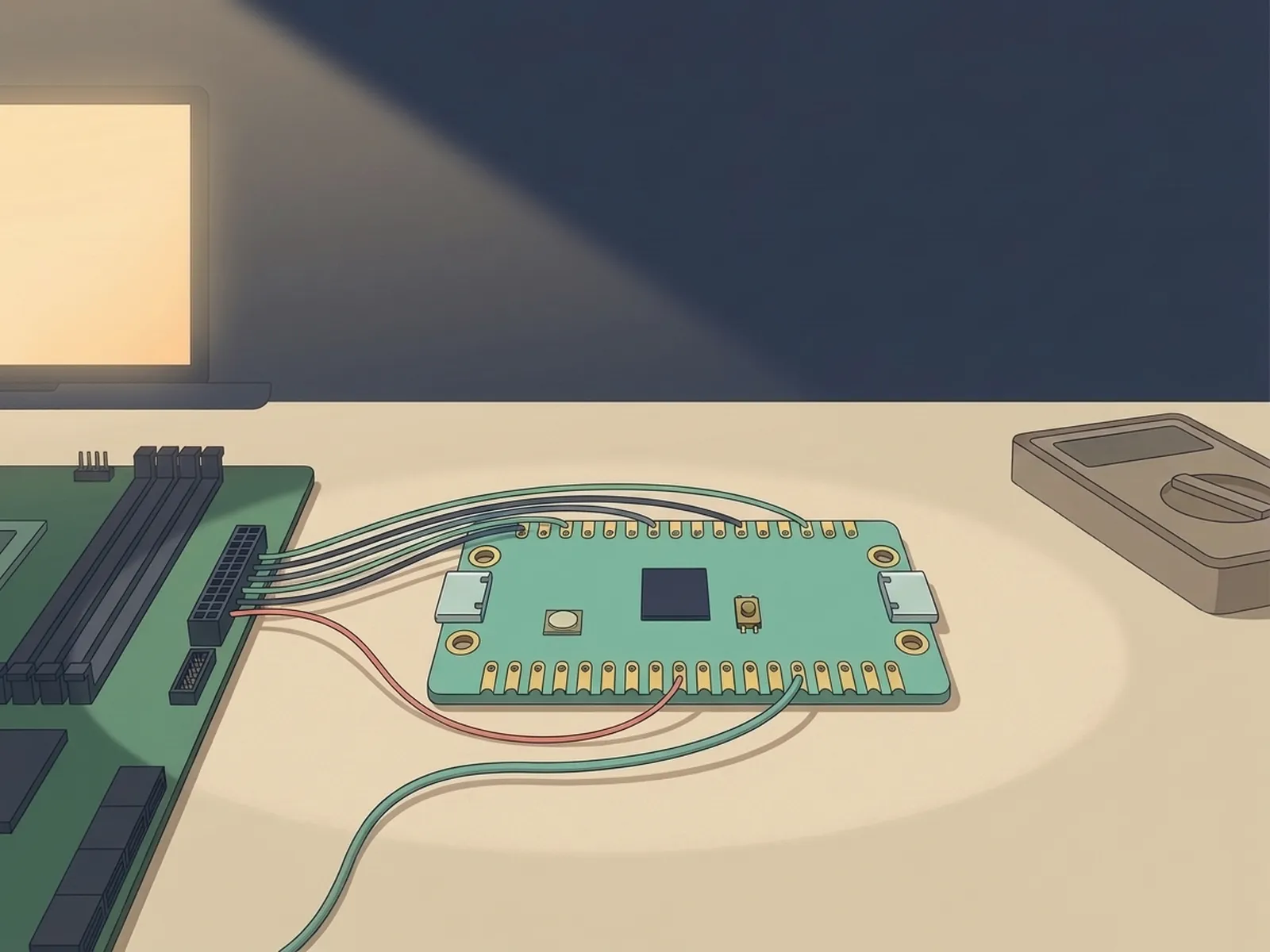
The 20-second version: a Raspberry Pi Pico running free open-source firmware, seven wires, and the Windows tool J-Runner together make a working Xbox 360 NAND programmer — the thing that reads and writes the console's flash memory. The PC software does the thinking; the Pico provides the timing-precise connection to the console. This page explains what the board is actually doing on each of those wires — the beginner questions underneath (what a NAND dump is, what RGH and JTAG actually mean) are answered from zero by our RGH and JTAG explainer.
The full build — wiring photos, software and safety steps — lives in the PicoFlasher project: start an RGH or JTAG build with a Raspberry Pi Pico.
The job description — what the Pico is doing
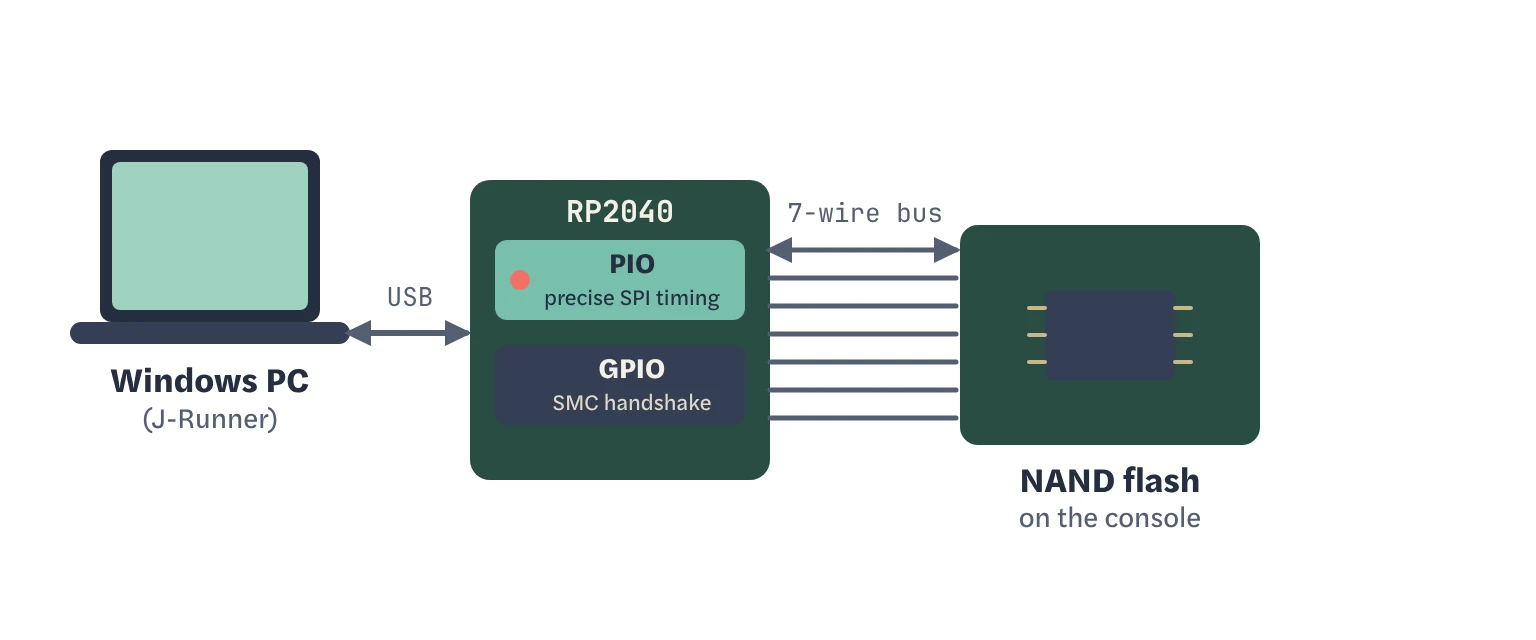
PicoFlasher is open-source firmware (the original port is by balika011; the fork our project page documents is 15432's, and the line the ConsoleMods wiki now recommends is hax360's continuation on Codeberg). Flash a Pico with it, and the board becomes two things at once: a USB device your PC sees, and a 7-wire flash bus that clips onto the Xbox 360 motherboard. On the PC side it works with J-Runner with Extras or J-Runner-Pro on Windows; every read and write you click in J-Runner travels down the USB cable and out those seven wires.
The division of labour matters: the Pico never decides what to write. It receives commands over USB and turns them into electrical signals whose timing is exact — the part a PC operating system is bad at and a microcontroller is built for.
The seven wires — what every GPIO does
The four SPI lines (GP0–GP3)
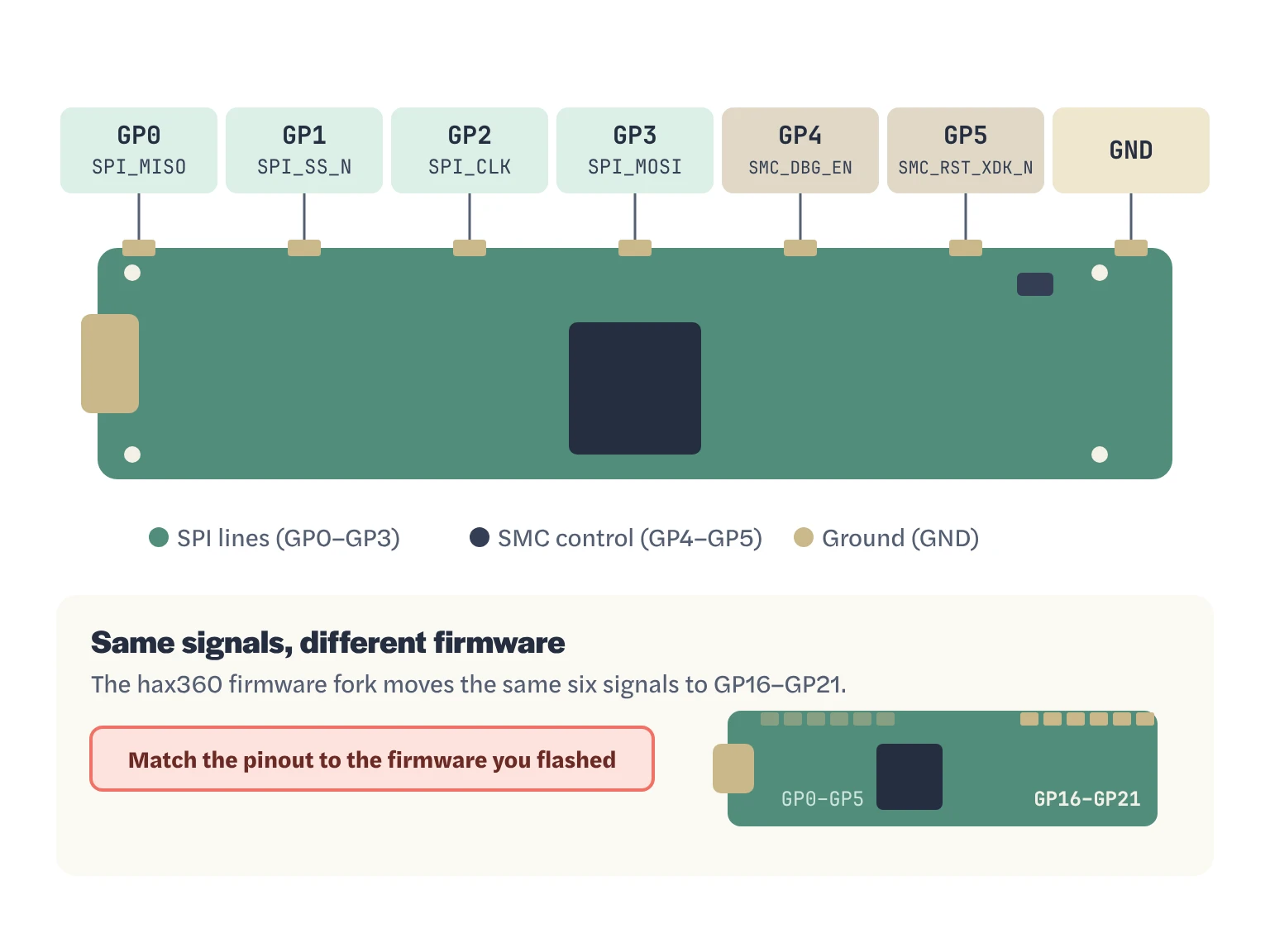
Four of the wires form an SPI bus — the standard short-distance link electronics use to move data between chips. In 15432's fork they sit on the Pico's first four GPIO pins:
| Pico pin | Xbox 360 signal | What it does |
|---|---|---|
| GP0 | SPI_MISO | Data back into the Pico (Memory In / Slave Out) |
| GP1 | SPI_SS_N | Chip-select: wakes the flash chip for a transaction |
| GP2 | SPI_CLK | The clock the Pico supplies; every bit moves on a tick |
| GP3 | SPI_MOSI | Data out of the Pico (Memory Out / Slave In) |
MISO and MOSI carry the data in each direction, CLK is the metronome that keeps both ends in step, and SS_N is the "you're being spoken to" line. That's all standard electronics vocabulary — the names on the console side come straight from the firmware's wiring table.
The two SMC control lines (GP4, GP5) and ground
The last two signals are not data — they are crowd control. The Xbox 360's system-management controller (SMC) is the always-on chip that runs the console even when "off", and it talks to the same flash. SMC_DBG_EN and SMC_RST_XDK_N hold that controller in debug/reset so the flash bus is quiet while the Pico uses it; two consoles' worth of traffic on one bus is how dumps get corrupted. The seventh wire is simply GND — a shared ground reference so both ends agree what 0 V means.
Same signals, different pins — read this before you solder
Match the pinout to the firmware you actually flashed. The ConsoleMods wiki currently marks 15432's firmware "not recommended" in favour of hax360's fork (it integrates 15432's features, adds UART monitoring, and the wiki notes better stability and 4 GB support) — and hax360's firmware moves the same six signals to GP16–GP21 on a standard Pico or Pico 2, keeping GP0–GP5 only on RP2040-Zero boards. The GP0–GP5 table above is the 15432 wiring because that is the build our project page documents; if you flashed hax360's UF2, wire GP16–GP21 instead. (15432's fork also documents an optional ISD12xx audio-feedback chip on GP15 and GP26–GP29; the hax360 line dropped ISD flashing in v4.1.)
How the RP2040 speaks NAND
PIO, not bit-banging
The SPI traffic is not generated by a software loop flipping pins as fast as the CPU can manage. The RP2040 chip inside the Pico has PIO blocks — "programmable I/O", small deterministic state machines that run independently of the main CPU. PicoFlasher's firmware (built on the official Pico SDK) hands page reads and writes to those state machines; they toggle the SPI lines with cycle-accurate timing while the CPU handles the USB conversation. That determinism is exactly why a $5-class board can keep up with purpose-built programmers on a job where jitter means corrupt data.
The software-timed part: the SMC handshake
Not everything is hardware-timed. Quieting the console's SMC is plain, patient GPIO work: reading the firmware source, the sequence drives SMC_DBG_EN low, walks SPI_SS_N and SMC_RST_XDK_N through their paces with 50-millisecond pauses between steps, waits a further 200 ms after the SPI engine restarts, and only then trusts the bus. Handshakes like this are measured in fractions of a second, done once per session — timing-precise hardware is for the megabytes that follow, not the handful of control flips.
A NAND read, step by step
Over that SPI link the flash is addressed through registers, like a tiny mailbox: a status register (0x04) the Pico polls until the chip is ready, a command register (0x08), an address register (0x0C) that takes the block address, and a data register (0x10) the firmware reads four bytes at a time. Each NAND page is 0x200 (512) bytes plus 0x10 (16) bytes of "spare" area — housekeeping data the console uses — and both come down the same pipe. When the status word reports a bad block or an ECC (error-checking) flag, the firmware notes it and keeps going rather than stopping; J-Runner reconciles those flags afterwards. The 4 GB flash on Corona consoles is reached over the same SPI route as the ordinary 16 MB chips. And because a read can silently misread, J-Runner reads the NAND twice and compares the dumps automatically before calling either one good — never skip that.
Why the Pico replaces a dedicated flasher
The ConsoleMods wiki rates PicoFlasher "one of the fastest NAND programmers" that is "considerably cheaper while being more readily available than most" — from a community that maintains the alternatives it is measured against. On price, coverage of the same 2026 build landed at "a $4 microcontroller" (Tom's Hardware) and "two $5 Raspberry Pi Picos" (hwbusters); call it a $4–5 board, and our project page keeps the whole build in its under-$15 band either way. Availability is the quiet winner: Picos ship worldwide from dozens of distributors, while dedicated console programmers come and go with small vendors.
It is also part of a pattern. The same board on our Raspberry Pi Pico board hub shows up as the official debug probe for Arm development, as Pico.Lab, a browser-based scope and logic analyser, and even as PicoDVI, driving HDMI video from its PIO state machines. One $4–5 part, a drawer of roles.
Where the Pico stops being the right tool
Flash memory: yes. Glitch chips: mostly no. The wiki notes the RP2040 has been demonstrated as a glitch chip only experimentally (balika011's PicoRGH proof of concept) and cannot run in sync with STBY_CLK, the console's standby clock — so it cannot match a real glitch chip's success rate, and the wiki does not recommend Pico-as-DirtyJTAG for programming glitch chips over a dedicated programmer "due to potential instability".
The honest division of labour showed up in October 2026, when Tom's Hardware covered Joshua Kennedy finishing a glitch hack he had shelved since 2017: one Pico running PicoFlasher dumped the NAND, and a second Pico programmed Octal450's timing files onto a Matrix CoolRunner glitch chip. The Picos did the reading and the writing; the glitch chip did the glitching. That is the shape that works.
Pico 2 and RP2350 — the newer firmware
The maintained hax360 line runs on the RP2350-based Pico 2 as well (Pico 2 support since v4.2, with Waveshare RP2040-Zero and RP2350-Zero builds alongside) — so a Raspberry Pi Pico 2 or a board like the Waveshare RP2350-Plus flashes the same consoles, picking the UF2 that matches your board from the releases page. The MODI Pico 2 Flasher X360 TURBO fork remains an alternative RP2350 route with its own J-Runner integration package and published read/write timings.
What to do next
New to the terms? Read RGH and JTAG, explained in plain English first. Then take the build itself to the PicoFlasher project: start an RGH or JTAG build with a Raspberry Pi Pico — wiring photos, software steps and the full parts list, including the Pico part page with buying links.
Four safety lines before you solder: soldering to a motherboard can permanently damage it; keep a verified NAND backup before any write; only modify consoles you own; and read the NAND twice, comparing dumps, before writing anything. More builds and explainers: More guides.
MCU Atlas is an independent site, not affiliated with Microsoft, the PicoFlasher developers (balika011, 15432, hax360), or the ConsoleMods wiki. Xbox 360 and Raspberry Pi Pico are trademarks of their respective owners.
Sources
15432/PicoFlasher README — wiring table (GP0–GP5 + GND), ISD12xx option, connection diagram. github.com/15432/PicoFlasher (fetched 2026-11-12)
15432/PicoFlasher firmware source, xbox.c (GPL-2.0 header, © Balázs Triszka) — PIO includes, SMC handshake timing, register map, page/spare sizes, eMMC route. github.com/15432/PicoFlasher (fetched 2026-11-12)
ConsoleMods wiki, Xbox 360: PicoFlasher — speed/cost/availability quote, hax360 recommendation and GP16–GP21 pinout, 15432 "not recommended" notice, glitch-chip and DirtyJTAG limits, J-Runner double-read procedure. consolemods.org (fetched 2026-11-12)
hax360/PicoFlasher (Codeberg) — maintained line, per-board UF2s. codeberg.org/hax360/PicoFlasher
MCU Atlas, PicoFlasher project page — 15432 wiring as documented build, Pico 2 coverage, costBand, Kennedy story, safety lines. mcuatlas.com/projects/picoflasher-xbox-360-nand-flasher-on-a-raspberry-pi-pico/
Tom's Hardware (Oct 2026) — "$4 microcontroller" headline figure; Kennedy two-Pico RGH completion. tomshardware.com
hwbusters (2026) — "two $5 Raspberry Pi Picos" figure. hwbusters.com
modyfikatorcasper/modi-pico2-flasher-x360-turbo — RP2350 fork, J-Runner package, published timings. github.com
MCU Atlas, Raspberry Pi Pico part page — the board's other bench roles. mcuatlas.com/parts/raspberry-pi-pico/