ESP-FLUTTER: a flying RC butterfly on a XIAO ESP32-C3
Max Imagination's flapping-wing RC butterfly: a XIAO ESP32-C3 drives two servos, flown from a phone web app or an RC radio.
What it is
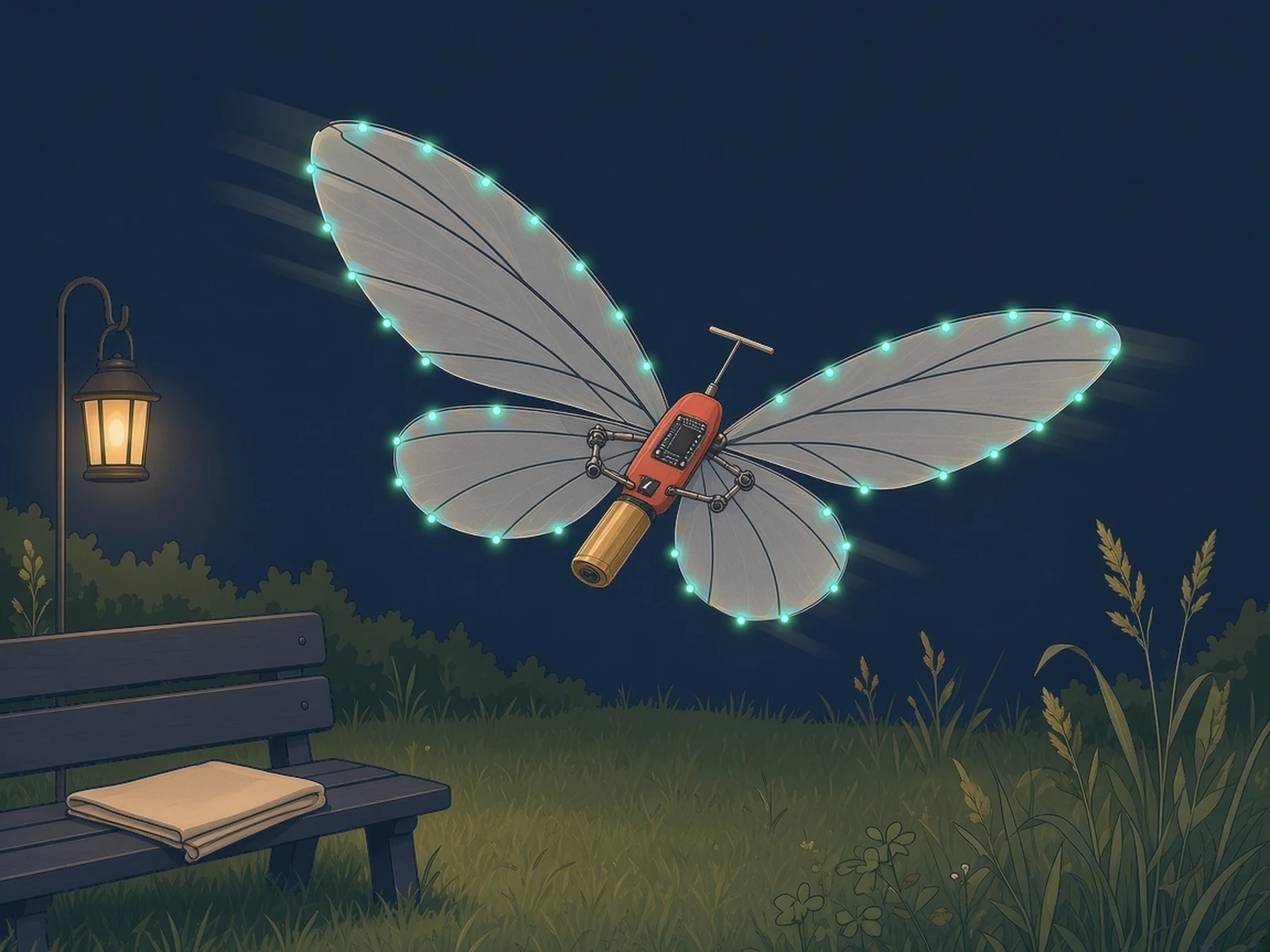
A 70 g RC butterfly that flies by flapping its wings, steered from your phone or an RC radio.
What you need
- Seeed XIAO ESP32-C3
- 2 × SDS1601 digital servos
- 2 × 220mAh 45C LiPo cells (2S)
- Carbon fiber rods
- 3D-printed frame paid STL files on Cults3D
How hard
Advanced: soldering, a 3D-printed frame, hand-built film wings and a lot of tuning. The creator recommends prior electronics and RC experience.
Key Facts
- Creator's figures: about 70 g with battery, about 5 min per battery, longest continuous flight 1 min 9 s
- Control: phone web app over Wi-Fi (about 25 m range per the creator), ESP-NOW transmitter or ELRS receiver (CRSF)
- Firmware: PolyForm Noncommercial 1.0.0 (README), free for personal use
- 3D-printed frame (STL/STEP) is a paid download on Cults3D; Gerbers, wing blueprints and wiring diagrams are free
- Creator: Max Imagination. Spotted by Praveen Kumar Verma (@Alacritic_Super) on X
About This Project
ESP-FLUTTER is a butterfly-shaped ornithopter by Max Imagination. It has no propellers: a Seeed XIAO ESP32-C3 drives two digital servos that flap plastic-film wings lined with LEDs. You fly it from a web app on your phone over its own Wi-Fi, or from an ESP-NOW transmitter or an ExpressLRS receiver. The firmware lets you tune flap speed, amplitude and waveform, and has flight profiles, an arming mode, battery monitoring and an experimental phone-tilt mode. The creator's video walks through the whole build, including a modular version on perfboard and a version on his own PCB. The firmware (GitHub), Gerbers, wing blueprints and wiring diagrams (Google Drive) are free; the 3D-printed frame files are a paid download on Cults3D. The creator says it's for makers with prior electronics and drone/RC experience. The creator credits Ctorque Tech (@CTorque on YouTube) for the wing blueprint file and some design inspiration. We found it through Praveen Kumar Verma (@Alacritic_Super) on X.
Source & Attribution
Illustration
Parts Needed
- Seeed XIAO ESP32-C3
- 2 × SDS1601 digital servos
- 2 × 220mAh 45C LiPo cells (2S)
- 5V buck converter (modular version) or the ESP-FLUTTER PCB
- Carbon fiber rods (1 mm and 1.5 mm, 400 mm)
- 3D-printed PETG frame and TPU servo guard (paid STLs on Cults3D)
- Produce-bag film or 20D ripstop for the wings
- Optional: ELRS receiver and RC radio
Steps
- 1
Get the files
Download the firmware release from GitHub and the Gerbers, wing blueprints and wiring diagrams from the creator's Google Drive folder (linked in the video description). The frame STL/STEP files are a paid download on Cults3D.
- 2
Print and build the frame and wings
Print the frame in PETG and the servo guard in TPU. Cut the carbon rods to the blueprint and cover the wings with produce-bag film or ripstop, following the video.
- 3
Wire it up
Follow the creator's wiring diagram (modular) or build the PCB. On the XIAO ESP32-C3 the firmware uses D0 for the left servo, D1 for the right servo, D2 for battery sensing and D3 for the wing LEDs.
- 4
Flash the firmware
In Chrome, open esptool-js, connect the XIAO and flash the release files at the addresses in the README (partitions.bin, boot_app0.bin, firmware.bin). Leave Erase All Flash off.
- 5
Connect and tune
Join the butterfly's Wi-Fi access point and open the web app at 192.168.4.1 (the access point name and password are in the README). Arm it, then tune flap frequency, amplitude and trim in small steps.
- 6
Fly safely
Start in an open space, away from people and faces. It runs on a 2S LiPo: charge it with a proper LiPo charger, never unattended, and stop using a puffed cell. Hover mode does not stabilise it automatically, and the README's experimental board profiles (XIAO ESP32-S3, ESP32 DevKit) are not flight-tested. The video ends with a troubleshooting guide.
Bill of Materials
Parts list
9 parts · 7 linked
Heads up: some Buy links are affiliate links. If you buy through one, MCU Atlas may earn a small commission at no extra cost to you. It never changes which parts we list. How this works

2× SDS1601 digital servo (with horns and screws)
Choose the SDS1601 option.

1× T antenna
1× 5V buck converter
Choose 5V (the listing defaults to 3.3V).

14 + 3× Carbon fiber rods, 400 mm (1 mm and 1.5 mm)
Pick both 1x400mm and 1.5x400mm.
1× 3D-printed frame (PETG) and servo guard (TPU)
1× ESP-FLUTTER flight-controller PCB (optional, instead of perfboard)
1× ELRS receiver
Choose Nano 1P, No plug.
Not included: Small parts from the creator's list: SI2300 N-MOSFET, 0805 LEDs (about 50 for the wings), 3 mm LEDs, resistors, JST connectors, 20/30 AWG wire and 36 AWG enamelled wire, Wings: 15-micron produce bag or 20D ripstop, plus UHU POR, CA glue, Kapton and masking tape (wing blueprints on Google Drive), RC radio or ESP-NOW transmitter (optional), LiPo charger, soldering tools and a 3D printer
Related Projects