esp32-thinks: a talking AI assistant with a swappable brain
Turn the retail SenseCAP Watcher (ESP32-S3) into a talking AI assistant whose STT, chat and TTS brain is three swappable OpenAI-compatible endpoints.
What it is
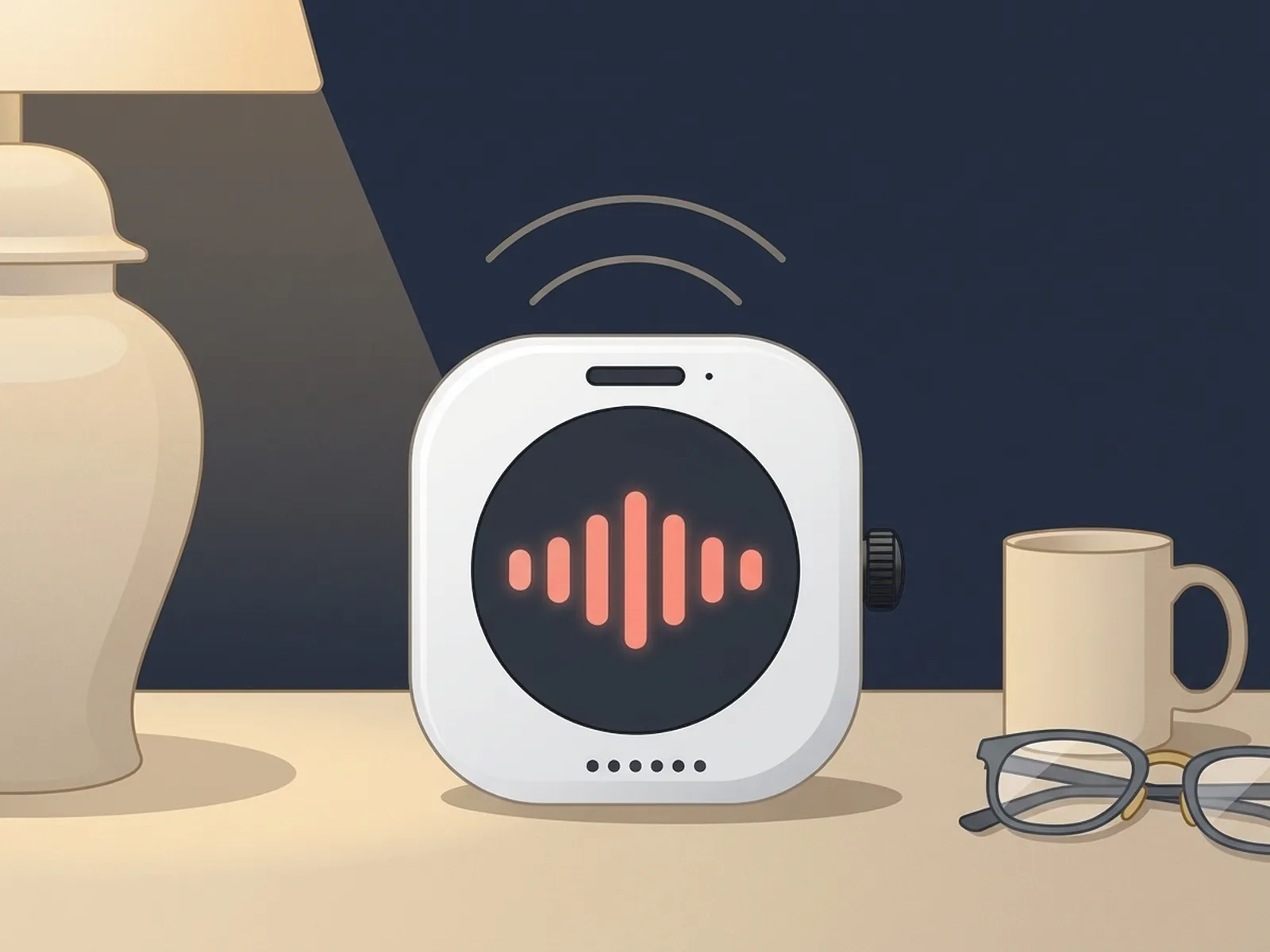
esp32-thinks turns the Seeed SenseCAP Watcher — a retail ESP32-S3 device with a mic, a speaker and a round display — into a talking AI assistant you actually own. Say "Hi, ESP" or press the knob, ask anything, and the answer is spoken back sentence-by-sentence while the model is still writing. The trick worth stealing: speech-to-text, chat and text-to-speech are three independent endpoints in one config file, each pointed at any OpenAI-compatible server. Swap the brain, keep the gadget. MIT, CI and tagged releases; a reviewable patch on Meta's muse-gadget-sdk. MCU Atlas is not affiliated with the maker.
What you need
- Seeed SenseCAP Watcher W1-B the whole BOM — one complete retail device (ESP32-S3, mic, speaker, round LCD, PTT knob), no soldering. Not in the MCU Atlas parts catalog, so there's no Buy link; order from Seeed
- Linux or macOS build host with ESP-IDF v6.0.x one-time toolchain install; this project builds from source — no browser flasher
How hard
Intermediate, and only because of the toolchain: there is no wiring and no soldering — the entire build is one retail device. You install ESP-IDF v6.0.x once, edit a config file of three endpoint URLs, and run three scripts. If you have flashed an ESP32 before, the hard part is already behind you.
Key Facts
- Talking AI assistant on the retail Seeed SenseCAP Watcher W1-B (ESP32-S3, mic, speaker, 1.45" round LCD) — no soldering, one-device BOM
- Say "Hi, ESP" (on-chip esp-sr WakeNet10 wake word) or hold the knob; answers are spoken sentence-by-sentence while the model is still generating
- STT, chat and TTS are three independent endpoints in one config, each pointed at any OpenAI-compatible server — mix providers per task, no vendor lock
- Reviewable patch on Meta's open-source muse-gadget-sdk at pinned commit 812c46f, with an explicit "what's theirs, what's ours" split
- MIT-licensed (LICENSE file verified); three CI workflows and 271 host tests on every push; nine tagged releases in the first week (to v0.2.12)
- Answers follow your language — English, Chinese and Korean tested, English by default
- What MCU Atlas verified: repo, MIT license, README claims, tags and CI, re-checked live via the GitHub API on 2026-11-27 — no on-device testing; on-device behavior (latency, wake word) is the maker's reporting
About This Project
esp32-thinks (github.com/raullenchai/esp32-thinks) is a voice assistant for the Seeed SenseCAP Watcher W1-B: an ESP32-S3 with a 1.45" 412×412 round LCD, an ES8311 speaker codec, an ES7243E mic and a push-to-talk knob. Say "Hi, ESP" — the wake word runs on-chip via Espressif's esp-sr WakeNet10, no cloud listener — or hold the knob, ask your question, and get a spoken answer streamed sentence-by-sentence: each sentence is synthesized the moment it lands and appended to the audio already playing, so the first word arrives while the model is still generating. Replies follow your language, with English, Chinese and Korean tested and English as the fallback default. The whole implementation is a reviewable patch against Meta's open-source muse-gadget-sdk at a pinned commit, so you can open the diff and see exactly what a voice assistant's brain is made of. MIT-licensed, with CI on every push and nine tagged releases in the project's first week.
The pitch: the lock is in the firmware
The README's own "Why" section puts it better than a summary could: "Cloud assistants rent you a brain: one vendor's models, one vendor's pricing, one vendor's uptime, and your voice on their servers. The gadget hardware is fine — the lock is in the firmware." That's the whole project in two sentences. Every consumer AI gadget fuses its three brain-jobs behind one vendor's cloud so the seams are invisible — and unchangeable. esp32-thinks buys back the hardware and makes the seams the feature.
How it works: three jobs, three endpoints
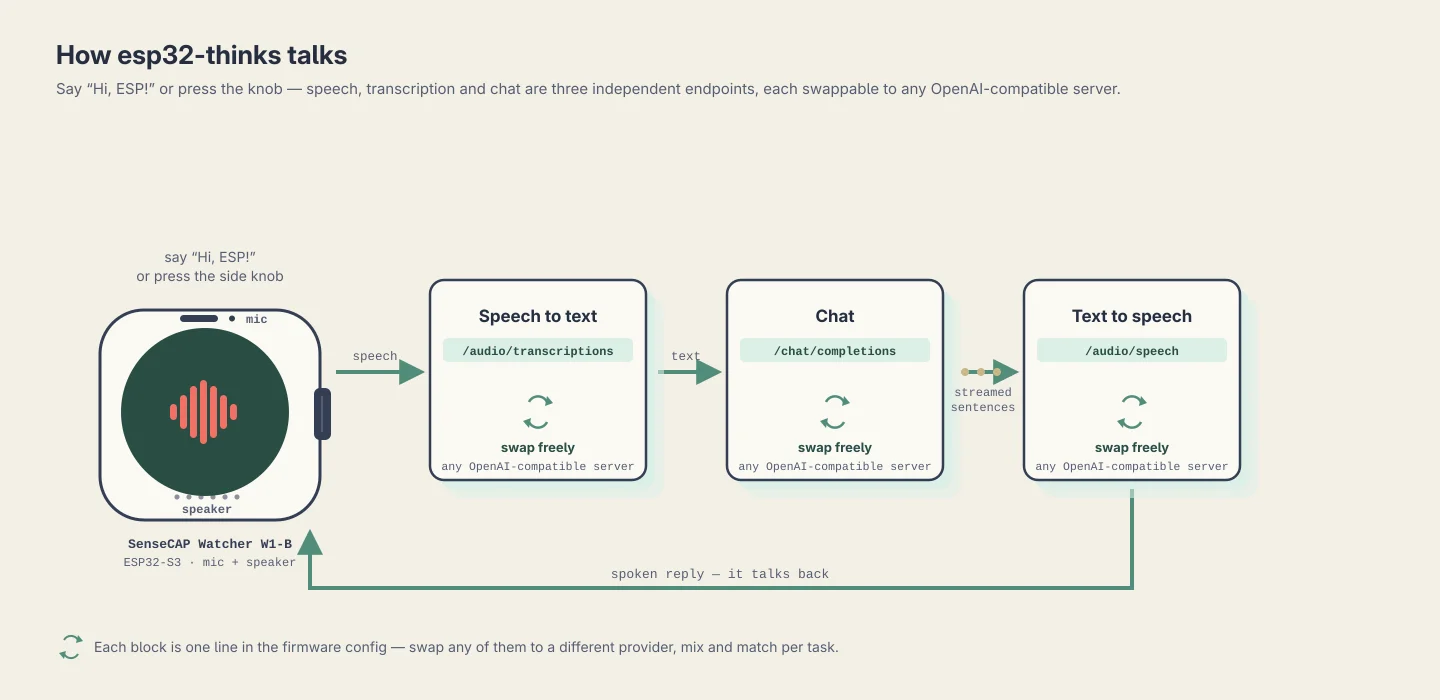
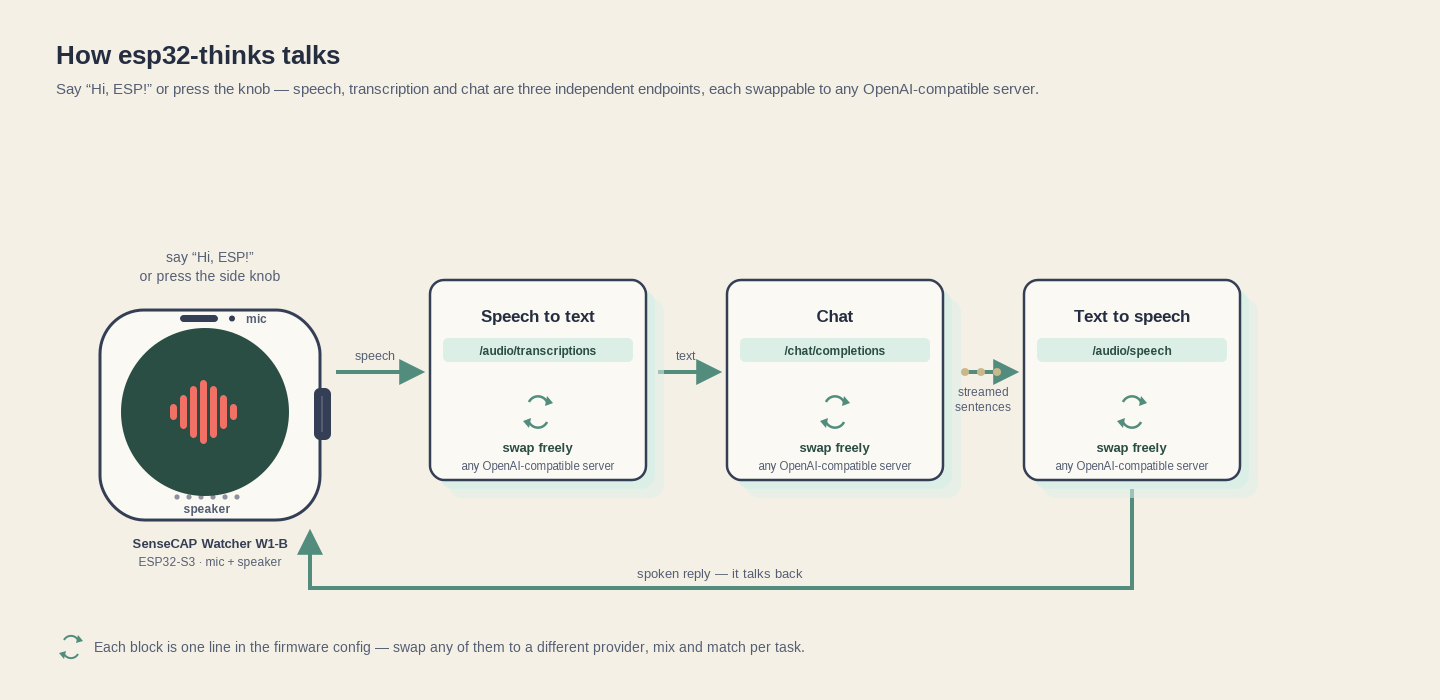
Strip the marketing off any "AI voice assistant" — smart speaker, pendant, desk gadget — and the same three jobs are piped together: turn speech into text (STT), think about the text (chat), turn the answer back into speech (TTS). On the Watcher it reads like this:
mic → STT endpoint (speech to text) → chat endpoint (thinks up the answer, streamed) → TTS endpoint (text back to speech) → speaker
What makes esp32-thinks a lesson rather than a demo is that each arrow is a separate, swappable line in one config file. Transcription goes to any OpenAI-compatible `/audio/transcriptions` server; chat to any `/chat/completions` server with SSE streaming; speech to any `/audio/speech` server. Four presets ship in the repo (openai, quicksilver, openmuse, custom), and you can mix providers per task — cheapest transcription here, smartest chat model there, the voice you actually like somewhere else — changed with a config edit and a rebuild. Once you've seen the pipeline this clearly, every AI gadget on a store shelf demystifies: it's these three jobs plus a microphone, and the only question worth asking is who controls each endpoint.
What it feels like to use
The seams show up in real time. The chat stream is parsed at sentence boundaries (it handles ASCII and CJK punctuation), and speech synthesis starts on the first complete sentence rather than after the full reply — the README's own measurements put typed warm turns at 2.2–2.5 seconds for English and Korean and about 6.8 seconds for Chinese, and its nightly soak on 2026-10-19 logged 2.2, 6.8 and 2.8 seconds for the same three languages; voice turns run "roughly 3–5 s from end of speech to first sound." The README is careful to call these "individual samples, not latency guarantees," and so should you be. Small touches make it feel finished: press the knob mid-reply to barge in and interrupt; a silence guard keeps quiet turns from hanging; a stall watchdog gives wedged peripherals a 20-second deadline and reboots the device rather than letting it sit dead; and Wi-Fi provisioning is headless — no vendor app, no BLE pairing, no account.
Hardware: one retail device, no soldering
The entire BOM is the Seeed SenseCAP Watcher W1-B — a complete retail product with everything onboard. No soldering, no add-on boards, no cable salad. The project's roadmap names more SDK-supported boards (Waveshare and M5Stack are cited), but the Watcher is the device this firmware targets and tests today, so start there.
Getting started: three commands
After a one-time install of ESP-IDF v6.0.x, setup is three commands from the repo: ./scripts/backup-nvs.sh (one-time factory backup), ./apply.sh ../muse-gadget-sdk --preset quicksilver, then ./build-and-flash.sh. Fill in your three endpoint URLs, flash, and — in the README's words — "unplug, re-plug, and talk — press the knob, or just say 'Hi, ESP'." There's also an optional in-repo openmuse/ agent layer that adds location, weather, time and memory skills plus an STT proxy, if you want the assistant to know more than a raw chat endpoint does. The full step-by-step, including the SDK clone, is in the tutorial below.
Honest status: young, but engineered like it isn't
The repo is weeks old at the time of writing (first push October 2026, nine tagged releases between v0.2.1 and v0.2.12 in the first week), but the engineering habits are older than the project: three CI workflows check every push — the v0.2.11 notes describe "patch integrity, a clean SDK clone + headless apply.sh, and 271 host tests," plus weekly Watcher firmware builds — and a real 21-hour soak test caught a wedged I2C expander that kept voice and Wi-Fi running while the device "looked frozen to its owner," then fixed it with an expander-bus watchdog. What to keep in perspective: this is one builder's fast-moving v0.2.x project with a single supported device, not a product. The value isn't polish — it's that the entire brain is a readable patch you can audit, learn from, and rewire.
License and attribution
esp32-thinks is MIT-licensed (verified from the LICENSE file in the repo), built as a patch on Meta's open-source muse-gadget-sdk. The project lives at https://github.com/raullenchai/esp32-thinks, with tagged releases and CI at https://github.com/raullenchai/esp32-thinks/releases. Credit for the firmware goes to raullenchai; credit for the underlying SDK to the muse-gadget-sdk authors; the SenseCAP Watcher is Seeed Studio's product. MCU Atlas is not affiliated with any of them — this page is an independent look at the build.
Skill takeaway
The transferable idea: "AI gadget" is not one technology, it's three jobs piped together, and the interesting design question is who owns each stage. If you want to poke at the ESP32-S3 end of voice hardware, the Espressif ESP32-S3 is the chip doing the listening here — on-chip wake word and all — and the ESP32 hub (/esp32/) has more builds that push it. Read the muse-brain.patch with the README's "what's theirs, what's ours" split open next to it, and you'll never look at a smart speaker the same way again.
What we verified, and what we didn't
What MCU Atlas verified first-hand: the repo, its MIT LICENSE file, the README's claims, the nine tags and the three CI workflows — all re-checked live through the GitHub API on 2026-11-27. What we did not do: run this firmware on a Watcher (we own none), so every on-device behavior — the latency figures, the wake word's responsiveness, the barge-in — is the maker's own reporting, attributed as such throughout this page.
Source & Attribution
Illustration
How to Build It
Parts Needed
- Seeed SenseCAP Watcher W1-B — the entire BOM: a complete retail device (ESP32-S3, mic, speaker, 1.45" round LCD, push-to-talk knob), no soldering. Not in the MCU Atlas parts catalog, so there is no Buy link — order from Seeed.
- A Linux or macOS build host with ESP-IDF v6.0.x (one-time install) and a USB data cable for flashing
Steps
- 1
See what you're building
One device, three swappable brain-jobs. The Watcher's mic records your question; a speech-to-text endpoint turns it into text; a chat endpoint thinks up the answer and streams it; and a text-to-speech endpoint speaks each finished sentence while the model is still writing. All three endpoints are lines in one config file (provider_config.h), each pointed at any OpenAI-compatible server — mix providers per task. Say "Hi, ESP" (the wake word runs on-chip via Espressif's esp-sr WakeNet10 — no cloud listener) or hold the knob to start a turn; press the knob mid-reply to barge in and interrupt.
- 2
Install ESP-IDF v6.0.x (one-time)
On a Linux or macOS build host, install Espressif's ESP-IDF v6.0.x for the esp32s3 target (the project's CI pins v6.0.3; the repo's docs/REFERENCE.md Prerequisites section lists what it expects). This is the slow step — a toolchain download — and it is the only one: the project has no browser flasher, you build from source.
- 3
Clone, patch and configure your brain
Clone both repos side by side and check the SDK out at the pinned commit — the recipe targets it so patches apply cleanly: git clone https://github.com/facebookincubator/muse-gadget-sdk.git, then git -C muse-gadget-sdk checkout 812c46f, then git clone https://github.com/raullenchai/esp32-thinks.git and cd esp32-thinks. From the repo root, run the three commands in order: ./scripts/backup-nvs.sh ../muse-gadget-sdk /dev/ttyACM1 (one-time factory NVS backup — your restore path; use your port, ACM0 or ACM1), then ./apply.sh ../muse-gadget-sdk --preset quicksilver — or openai, openmuse or custom. apply.sh copies the pinned CAs, applies patches/muse-brain.patch and generates provider_config.h, asking for your keys, Wi-Fi and wake word: your three endpoint URLs live in that one file, each swappable.
- 4
Build, flash, and talk
./build-and-flash.sh ../muse-gadget-sdk /dev/ttyACM1 runs idf.py build plus a paced, CH342-safe flash of the firmware and the wake-word model — allow several minutes and never interrupt it. Wi-Fi provisioning is headless: with your Wi-Fi in the config from the previous step, the device self-provisions on boot — no app, no BLE pairing, no account. Then, in the README's words: "unplug, re-plug, and talk — press the knob, or just say 'Hi, ESP'." Optional: the in-repo openmuse/ agent layer adds location, weather, time and memory skills plus an STT proxy, if you want the assistant to know more than a raw chat endpoint does.
Bill of Materials
Parts list
1 parts · 0 linked
Heads up: some Buy links are affiliate links. If you buy through one, MCU Atlas may earn a small commission at no extra cost to you. It never changes which parts we list. How this works
1× Seeed SenseCAP Watcher W1-B
Learn
Docs & guides
Read these before you buy. These pages explain things; they don't sell anything.
- Source: raullenchai/esp32-thinks (MIT)The project: README with the why, the architecture, setup and performance sections, and the 'what's theirs, what's ours' SDK split.Docs
- Releases: v0.2.1 to v0.2.12Nine tagged releases from the project's first week; v0.2.11's notes carry the CI line (271 host tests) and the soak-test fix.Docs
- Upstream: facebookincubator/muse-gadget-sdkMeta's open-source gadget SDK the firmware is a reviewable patch against, at pinned commit 812c46f.Docs
Related Projects