The cheapest Meshtastic node we can recommend in good conscience is the Seeed XIAO ESP32-S3 & Wio-SX1262 kit at $10.90 from Seeed's own store (checked 2026-11-28; Seeed's US-warehouse option is $11.99). It is a complete, working node — board, LoRa radio, both antennas, and Meshtastic firmware already flashed at the factory — so the only other thing you need is the phone already in your pocket. Buy two and you have a real Meshtastic starter kit — a two-node mesh — for $21.80.
This guide answers the three questions that bring people here: which board is genuinely the cheapest (and what the cheap picks give up), exactly what a Meshtastic starter kit costs item by item, and how Meshtastic compares to MeshCore if you are choosing between the two firmwares. Every price below carries the date we last checked it at the seller's own store — a buying guide whose numbers have no dates is a guide you cannot trust.
The cheapest Meshtastic node (and what you give up)
The Seeed XIAO ESP32-S3 & Wio-SX1262 kit at $10.90 (seeedstudio.com, checked 2026-11-28, in stock) is the cheapest complete Meshtastic node you can buy today. "Complete" is the important word: the box contains the ESP32-S3 main board, the Wio-SX1262 LoRa radio module, a LoRa antenna and a Wi-Fi antenna, and it ships pre-flashed — Seeed's product page describes it as ready for Meshtastic out of the box. No flashing, no extra parts, no soldering to get on the air.
It is also cheaper than the alternatives at every turn. The least expensive Heltec board is $14.90 and has no screen either. Even parting the Seeed kit out yourself loses: the Wio-SX1262 radio module alone is $5.09 (checked 2026-11-28) and the bare XIAO ESP32-S3 board is $7.49 (checked 2026-11-28) — $12.58 for parts that are not guaranteed to work together, because Seeed's own compatibility notes say the standalone module pairing is not Meshtastic-supported. The bundled kit is both cheaper and safer.
What you give up at $10.90:
No display. Your phone is the screen, over Bluetooth or USB. That is the normal way to run a first node, and it costs nothing extra — but if you want a board with its own screen, the Heltec WiFi LoRa 32 V3 at $17.90–$19.90 (checked 2026-11-18) is the classic pick with a 0.96-inch OLED.
No battery in the box. It runs from USB-C, and the kit has charging circuitry built in, so you can add a LiPo later.
862–930 MHz only. Fine for the Americas, Europe and Australia; if you need 433 MHz, choose a Heltec board instead, which offers 433 and 470–510 MHz variants.
Not sold into mainland China (per Seeed's product page).
Here is the full field of boards people actually buy for Meshtastic, every price checked at the seller's own store:
| Board | Price (checked) | Screen | Best at |
|---|---|---|---|
| Seeed XIAO ESP32-S3 & Wio-SX1262 kit | $10.90 (seeedstudio.com, 2026-11-28) | none | Cheapest complete node; ships pre-flashed |
| Seeed XIAO nRF52840 & Wio-SX1262 kit | $13.99 (seeedstudio.com, 2026-11-18) | none | Low-power twin (nRF52) for battery nodes |
| Heltec Wireless Stick Lite V3 | $14.90 (heltec.org, 2026-11-18) | none | Cheapest pick with 433/470–510 MHz variants |
| Heltec WiFi LoRa 32 V3 | $17.90–$19.90 (heltec.org, 2026-11-18) | 0.96" OLED | Classic first board with a screen |
| RAK WisBlock RAK4631 | $17.99 module (store.rakwireless.com, 2026-11-18) | none | Solar routers; base board and antenna cost extra |
| LilyGO T-Beam Supreme | $37.12 / $40.35 (lilygo.cc, 2026-11-18) — sold out, both variants | OLED | GPS handheld form, when in stock |
| LilyGO T-Deck | $46.52 (lilygo.cc, 2026-11-17) | 2.8" + keyboard | Cheapest standalone, phone-less node |
| Seeed Wio Tracker L2 Pro | $69.90 (seeedstudio.com, 2026-11-18) | touchscreen | Finished gadget: GPS + touchscreen + 3000 mAh battery included |
| LilyGO T-Lora Pager | $95 (Amazon US, in stock) / $88 (lilygo.cc, sold out) (2026-11-15) | 2.33" + QWERTY | Polished pager handheld |
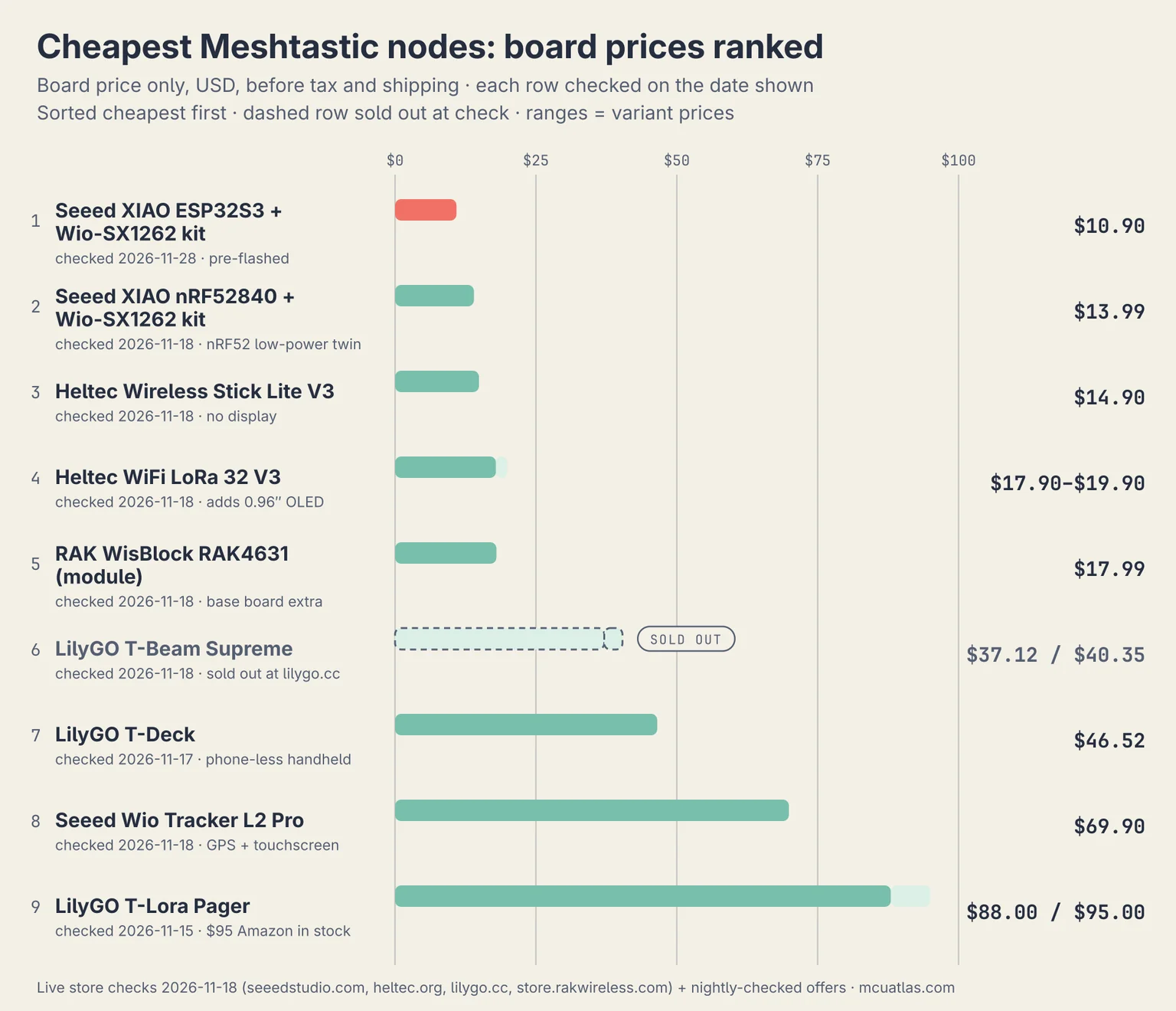
One price move worth knowing about: the Wio Tracker L2 Pro rose about ten dollars in a month (it was $59.42 on 2026-10-19), a good reminder to check the seller's page — or our part pages, which we re-check continuously — before ordering.
A Meshtastic starter kit that actually works
Skip the boxed "Meshtastic starter kits" you will find on marketplaces: the starter kit that actually works is two identical Seeed kits — $21.80 total, everything dated below. A mesh needs at least two nodes to be a mesh, and two pre-flashed, identical boards are the cheapest, best-documented way to get there. Here is the full bill of materials:
| Item | Qty | Unit | Line total | Source and checked date |
|---|---|---|---|---|
| Seeed XIAO ESP32-S3 & Wio-SX1262 kit (Meshtastic pre-flashed; LoRa and Wi-Fi antennas included) | 2 | $10.90 | $21.80 | seeedstudio.com, 2026-11-28 |
| Optional: 2 dBi SMA LoRa antenna, 868/915 MHz — better range than the included FPC antenna | 2 | $2.49 | $4.98 | seeedstudio.com, 2026-11-28 — needs an SMA-to-IPEX cable, which we have not priced |
| Optional: 1S 3.7 V LiPo battery, ~2000 mAh, connector to match the kit's battery pads | 2 | — | — | the Seeed 2200 mAh pack we priced at $9.90 (2026-11-18) is discontinued at Seeed's store (checked 2026-11-28) — any equivalent 1S LiPo works; we have not re-priced a replacement |
| Core total (just the two nodes) | $21.80 | |||
| Everything, with the antenna option | $26.78 | battery line unpriced — the Seeed 2200 mAh listing is discontinued (checked 2026-11-28) |
USB-C cables and your phone are assumed already owned; with just the two kits you can exchange your first encrypted message with nothing else on the table. If you would rather start with a screen on the board, two Heltec WiFi LoRa 32 V3s work out to $35.80–$39.80 (checked 2026-11-18) with the same two-node logic — you are paying the OLED premium twice.
One honest gap: every figure in this guide is a checked store price or a cited spec, not a bench measurement — we have not yet run our own range or battery tests on a pair of these kits, and this page will say so until we have.
Meshtastic vs MeshCore
Short answer: the same cheap boards run either firmware, but the two networks never talk to each other — pick one to start, and most beginners should start with Meshtastic. Here is the honest, source-checked comparison:
License. Meshtastic's official firmware is GPL-3.0 (the LICENSE file in the meshtastic/firmware repository on GitHub, checked 2026-11-18). MeshCore's firmware is MIT-licensed and free — though its phone app is a separate freemium product (see our MeshCore project page).
Hardware. The same boards run both: Heltec's own WiFi LoRa 32 V3 product page describes the board as widely used in well-known long-range wireless open-source projects such as Meshtastic and MeshCore (heltec.org, checked 2026-11-18). Any ESP32-S3 or nRF52840 board with an SX1262 radio from the table above is a candidate for either.
No interop. A MeshCore node only reaches other MeshCore nodes, and a Meshtastic node only Meshtastic nodes (our MeshCore project page). Our Trail Mate handheld lets one device boot into either firmware — but the firmware does not bridge between them.
Apps. Meshtastic ships official Android and iOS apps plus a browser client at client.meshtastic.org that works over USB. MeshCore pairs through its companion phone app (freemium, by Liam Cottle — some device features are paid unlocks) and a web client, with browser-based flashing at meshcore.io/flasher.
Device roles. MeshCore devices flash into one of three roles — Companion (phone-linked), Repeater (placed up high to forward traffic), or Room Server (a small bulletin board that keeps posts so late joiners catch up). Meshtastic nodes take client and router roles configured from the app instead.
Maturity. Meshtastic is the older, larger project: its current stable firmware is v2.7.26 (checked 2026-11-17), it is a registered trademark of Meshtastic LLC, and partner hardware ships factory-flashed. MeshCore is younger — as of 2026-11-14 its open-source companion firmware was not yet ported to the LilyGO T-Deck Pro, though the standalone Ultra firmware runs there.
Phone-less use. Both ecosystems reach fully standalone devices: Meshtastic runs on keyboard handhelds like the LilyGO T-Deck and T-Lora Pager (our Meshtastic without a phone guide covers them all), while MeshCore reaches the same class of hardware through MatterMesh OS for the T-Deck Plus and Max.
Which should you start with? If you want the biggest community, official phone apps and factory-flashed hardware today, start with Meshtastic — the whole starter path in this guide is Meshtastic. If the room-server bulletin-board style and dedicated repeater roles appeal to you, MeshCore rewards the same $10.90–$17.90 hardware, and you can flash the other firmware later; you just will not be talking across the divide.
The starter path: one node, then a pair, then no phone
Step 1 — one node, $10.90 (checked 2026-11-28). Order one Seeed kit. When it arrives, attach the antenna before applying any power — transmitting with no antenna can destroy the radio's amplifier in seconds, so antenna first, every time. Then pair the node to your phone with the official Meshtastic Android or iOS app, or plug it into a laptop and use the browser client at client.meshtastic.org. Our full beginner walkthrough of Meshtastic on ESP32 and nRF52 boards covers every step, from channels and encryption keys to your first message.
Step 2 — a pair, $21.80 (checked 2026-11-28). Add the second identical kit. Two nodes are the minimum real mesh: direct messages between them, plus honest range testing between your home and a friend's window. Each node can still reach the other via one hop — that is the whole idea, and everything you learn here (channels, hop limits, telemetry) scales when more nodes join.
Step 3 — go phone-less. Keep the two kits as your mesh backbone and add a standalone handheld when you are ready: the T-Deck at $46.52 (checked 2026-11-17) is the cheapest standalone node we can verify, with a screen, keyboard and trackball; the Wio Tracker L2 Pro at $69.90 (checked 2026-11-18) adds GPS, a touchscreen and a 3000 mAh battery; the T-Lora Pager at $95 on Amazon (checked 2026-11-15) is the polished pager option. Trail Mate turns the T-Deck or T-Lora Pager into an offline handheld with maps, routes and chat — and our Meshtastic without a phone guide covers every other way to run a node with no phone attached.
MCU Atlas is an independent educational site. We are not affiliated with or endorsed by Meshtastic (a registered trademark of Meshtastic LLC), MeshCore, Seeed Studio, Heltec, RAK or LilyGO. Every price on this page carries the date it was last checked at the seller's own store, and prices change often — always check the current listing before buying. Mesh networks are hobby systems and should not be relied on as your only means of emergency communication.